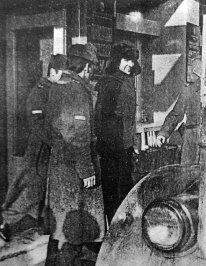
Я счастлив, что я удостоился учавствовать в страданиях Христовых. 3 апреля 1981 года. я был приговорён. Фотография после одного из заседаний суда в феврале-марте 1981. Группа верующих ожидала меня и Анатолию Кабинов удалось сфотографировать меня и перекинуть фотоаппарат назад в толпу (ему дали за эту фотографию срок два года). Эту фотографию моя жена Зинаида передала западным корреспондентам, когда ездила на кассационный суд (по апеляции) в Верховный суд РСФСР в Москве в августе 1981 года. Фотография из итальянской газеты, взятая писательницей книги Амалией с которая подарила мне свою книгу во время моего краткого времени в Риме летом 1988 года по дороге к выступлению в Конгрессе США о геноциде пятидесятников в СССР.
The emigration of thirty members of the Vashchenko and Chmykhalov families in June and July of this year briefly reminded the world of the confrontation between the Soviet regime and Pentecostal Christians which drove these two families — and many other families too — to seek emigration from the USSR in search of the freedom to worship God in peace in their own way and to bring up their children as Christians. (For more detailed information on the rise of the movement, see Michael Rowe’s article «Soviet Pentecostals: Movement for Emigration», RCL Vo!. 5, No. 3, 1977, pp. 170-74-Ed.)
Although the «Siberian Seven», as the members of the Vashchenko and Chmykhalov families who spent almost five years in refuge in the basement of the US Embassy in Moscow came to be known, never laid claim to be representative of other Christians who wished to emigrate they nevertheless became for many symbols of thousands of Pentecostal families who in the late 1970s declared their desire to make a new beginning in any non-communist country. At its peak this movement for emigration embraced some thirty thousand adults and children from Pentecostal families all over the USSR, including about 250 from the «Siberian Seven’s» home town of Chernogorsk.
Emigration in the quest of religious freedom is by no means a new phenomenon in the Soviet Union; indeed it has a history stretching back to the Russian Empire.
Although it has often been an individual decision, emigration has also in the past been a mass movement, for example in the case of the Dukhobors (The Dukhobors («Spirit-Wrestlers») are a sect which originated in southern Russia and eastern Ukraine in the latter part of the 18th century. Both in Tsarist and Soviet times (and in Canada) they have had a negative and unco-operative attitude to governments. Though regarding themselves as a Christian sect, they attach no importance to the Bible and interpret the
mysteries of Christianity in a rationalist manner-Ed.), whole communities of whom migrated to Canada both before and after the 1917 revolution.
The Pentecostal emigration movement began to emerge in 1976, stimulated in part by the Soviet Union’s apparent commitment in the 1975 Helsinki Agreements to facilitate freedom of movement. The number of Pentecostals declaring their intention of leaving the USSR grew steadily through 1977, 1978 and 1979, with little response from the authorities. Few were allowed to emigrate (other than Germans «repatriated» to West Germany), but the only arrests were of young men who refused to serve in the Soviet armed forces. The leaders of the movement claimed that thirty thousand adults and children wished to leave, and huge lists of names and addresses, some running into hundreds of pages, were compiled. A group of about eighty, including congregational leaders and ordinary members, representing churches mostly in southern Russia and Ukraine, led by Nikolai Goretoi, signed numerous appeals in this period addressed to the Belgrade Conference reviewing the Helsinki Agreements, to international organisations, western leaders and the leaders of non-Soviet communist parties.
They outlined the position in which Pentecostals found themselves — rejected by Soviet society yet held in the Soviet Union against their will, in. effect as slaves; they described Soviet policy towards the Pentecostals as genocide, in the sense of an attempt at total annihilation of a religious community.
Some of this group and others formed a «Fraternal Council of Pentecostal Churches». Although the Council took up the general issue of religious liberty it was in fact representative of the emigration movement rather than the wider Pentecostal movement as a whole.
In autumn 1979 the Soviet government began-to take action to neutralise the emigration movement. Some of the activists who had achieved most publicity for their individual situations were given exit visas — for example the families of Viktor Vasil’yev from Vilnius, and Vasili Gorelkin from Tapa, Estonia; both families emigrated in December 1979 and a number of other families followed, including two Baptist families — the Sklyarenko’s and the Vladyanu’s — who had been extremely active and had cooperated with Nikolai Goretoi.
At the same time arrests began: In October 1979 Fyodor Sidenko, a close associate of Goretoi, was arrested, charged with «slandering the Soviet state and social system» (article 190-1 of the RSFSR Criminal Code) and sent for psychiatric examination. He was subsequently sentenced in absentia at a closed hearing to indefinite detention in a special psychiatric hospital. In December Nikolai Goretoi was arrested, charged with «anti-Soviet agitation and propaganda» (RSFSR Criminal Code art. 70) and leading a banned religious organisation (RSFSR Criminal Code art. 227) -and sentenced in August 1980 to the maximum senterice of seven years’ strict regime camp and five years’ exile.
Other arrests followed, including that of Boris Perchatkin, one of the campaign leaders most well known to western correspondents and in dissident circles. He was sentenced to two years’ camp under article 190-1; six months after his release in August 1982 on completion of this sentence he was rearrested for allegedly carrying a hunting knife while living in hiding at a hunting lodge, and sentenced to a further two years.
However, on the whole the emigration movement leaders have been sentenced under the openly political charges of articles 190-1 and 70 or article 227, which relates directly to religious activity.
The arrests of 1979 and 1980 and the granting of exit visas to other activists had some effect in reducing the number of appeals reaching the West. The arrests provided greater discouragement than the encouragement of a few exit visas and it seems that some of those who added their names to the emigration lists in the belief that mass~migration was just round the corner quietly forgot about leaving. It is believed that families totalling some twenty thousand persons stilI hope to emigrate, but no comprehensive up-to-date lists are available.
Although a network of personal contacts remained, the only organisational activity was undertaken by a newcomer to the Pentecostal emigration movement, Vasili Barats. From a Catholic background, Barats had been an army officer and Communist Party member. He and his wife Galina had run into increasing difficulties on political grounds and both had resigned from the party and applied to emigrate before they became Pentecostal Christians.
Barats had founded a commitee for the right to emigrate, aiming to unite both religious and non-religious would-be emigrants, and for a time this committee became the only open spokesman for the emigration movement. In November 1981 the comimittee compiled 242 autobiographies (almost all of Pentecostals) and seventeen members signed an introductory statement to the Madrid Conference. Of the seventeen all but two — a Baptist and a German, whose denomination is not known — were Pentecostals. Although some of the autobiographies were of activists who had been associated in the past with Goretoi and Perchatkin none of these «old» activists actually belonged to Barats’ committee; in theory the «Fraternal Council» to which some of them belonged, continued to exist.
In 1982 the authorities took steps to crush Barats’ committee also. The Baptist member, Nikolai Cherkov, was arrested in February and later sentenced to three years’ strict regime camp. In May Pyotr Golikov was arrested and in August Barats himself.
Also in August two other emigration movemerit leaders, Vasili Shilyuk and Vasili Pirich, were arrested; they had not been members of Barats’ committee, but apparently cooperated with him. At the same time new charges were instituted against Eduard Bulakh, who was about to complete a one-year sentence. Barats’ wife Galina continued the work of the committee at the same time as trying to defend her husband.
She too was arrested, in March 1983, shortly before his trial, and the committee was effectively silenced. The sentences ranged from two and a half years’ camp to nine years’ camp and exile. The week that the Vashchenko’s emigrated Galina Barats was sentenced to six years strict regime camp and three years’ exile.
For the time being organised campaigning to emigrate seems to have ceased. But the commitment to emigration of many families continues. On the other hand the majority of Pentecostals have never expressed any desire to emigrate, and most senior leaders are opposed to emigration.
At ten to fifteen thousand adult Christians plus their children the emigration movement comprises no more than ten percent of the estimated membership of the Pentecostal churches. At least twice this number belong to registered churches of the Baptist Union, and the members of the two hundred autonomous registered churches are likely to outnumber the emigration movement. Certainly the largest part of the Pentecostal movement, probably the absolute majority, consists of those who are opposed to the limitations on church activity required of registered congregations and who feel called to make their Christian witness in Soviet society in spite of the many difficulties they encounter. Undoubtedly they are persecuted for their refusal to accept the limitations and register their congregations but the scale of persecution is unknown. While the emigration activists have been very vocal, these other Pentecostals have formed the silent majority.
MICHAEL ROWE

 Loading ...