A few decades after the establishment of the Baptist movement in Tsarist Russia, Pentecostalism, its Evangelical cousin, came to the Ukraine in the liberal years of the early twentieth century and built upon Baptist growth. The Pentecostal organization «Christians of the Evangelical Faith,» adherents of which were informally known as Voronaevtsy,1 was officially founded in 1926.2 They experienced just a few years of organized activity before Stalin’s repressive policies were introduced, Pentecostal worship became illegal, and the purges would claim the lives of countless church leaders. With the creation of the AUCECB in 1944 and an invitation extended to Pentecostalists to join this state-legitimized worship body, it appeared that the tide had turned for Pentecostal believers in the USSR. Soon, however, many who had joined the AUCECB withdrew their registration, and the Soviet Union witnessed a revival of unregistered Pentecostalists, albeit a clandestine revival carried out discretely so as to not attract3 attention. Читать далее
Архив рубрики: English
Washington Post about Boris Pechatkin’s meeting with president Ronald Reagan. May 1988: Muscovites wowed by Reagan
(The Washington Post by Finger Lake Times, Geneva June 1st 1988) MOSCOW — Just a few years ago. President Reagan was compared to a crazy cowboy and even to Adolf Hitler in the Soviet news media. In the last four days, the Soviet public has met the real Reagan, and to judge by the reactions of many, they have discovered someone they didn’t expect. Читать далее
Joel C. Rosenberg. More than 6 million self-described “evangelicals” voted for Obama. Why & what else do the exit polls tell us about how Christians voted?
As the smoke clears from the wreckage of the Romney defeat on Tuesday, some intriguing yet disturbing facts are coming to light. Читать далее
Владимир Минков. Обаме нужны еще четыре года правления, чтобы добиться окончательной победы над США
Почти все страны мира хотят видеть Обаму избранным на следующий президентский срок, но не большинство народа в его собственной стране. Почему? Читать далее
Keston Institute about Chuguevka church struggle and Zinaida’s and Ludmila’s Perchatkin hunger strike after 2nd sentencing Boris to Kolyma strictest camp
Soviet Religious Samizdat
Persecution of Pentecostals wishing to emigrate
Keston College continues to receive documents from PentecostaIs in the Soviet Union containing information about the various pressures to which they are subjected because of their desire to emigrate on religious grounds.
Forty-five members of the Pentecostal Church in Chuguyevka, Eastern Siberia (mainly of German nationality) have written an open letter addressed to the governments of the Soviet Union and West Germany and the participants at the 38th session of the General Assembly of the United Nations with the request that it should be distributed as widely as possible.
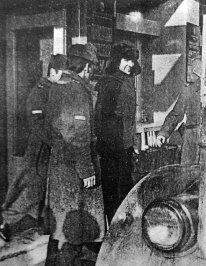
Я счастлив, что я удостоился учавствовать в страданиях Христовых. 3 апреля 1981 года. я был приговорён. Фотография после одного из заседаний суда в феврале-марте 1981. Группа верующих ожидала меня и Анатолию Кабинов удалось сфотографировать меня и перекинуть фотоаппарат назад в толпу (ему дали за эту фотографию срок два года). Эту фотографию моя жена Зинаида передала западным корреспондентам, когда ездила на кассационный суд (по апеляции) в Верховный суд РСФСР в Москве в августе 1981 года. Фотография из итальянской газеты, взятая писательницей книги Амалией с которая подарила мне свою книгу во время моего краткого времени в Риме летом 1988 года по дороге к выступлению в Конгрессе США о геноциде пятидесятников в СССР.
They write that from 2 January 1984 they will conduct a hunger strike unless the question of their emigration to West Germany is resolved in their favour. «Because of the harsh persecution of believers by the local authorities … as a result of which we have heen fined more than 4,000 roubles, have spent more than 220 days in investigation cells — and during one year some have been sentenced 6-9 times … On 30 March 1983 we sent our Soviet passports, together with a declaration renouncing Olir Soviet citizenship, to the Presidium of the Supreme Soviet of the USSR. »
In July they received an official refusal. The head of the emigration office in Vladivostok
told them, «there are no laws for you in olir country . Your declarations and receipts have been thrown in the dustbin and instead of West Germany there is a noose waiting for you.» (Open Letter to the Soviet and West German governments, etc., from Pentecostalsliving in Chuguyevka, undated, but 1983; 3 pp. [3933]. Photocopy.)
The Perchatkin and Istomin families from Nakhodka similarly announced their intention of starting a month-long hunger strike from 2 January 1984 because of the deadlock situation in which they found themselves. One of the women (Zinaida Perchatkin — ed.) has seven children and is expecting another child (has said — ed.): «Despite this, we have firmly resolved to take this step for the sake of our children or else they wiIl face the same fate as their fathers.» (Their fathers were sentenced on the basis of trumped-up charges and are serving camp sentences.) «If the Presidium of ,the Supreme Soviet of the USSR does not allow us to leave the Soviet Union, we will fast until death.» (Situation of families by Istomin and Perchatkin families, undated but 1983, 2 pp. [3975]. Handwritten original.) Читать далее
Michael Rowe. The Soviet Pentecostal Emigration Movement (about Boris Perchatkin’s 2nd sentence to Kolyma strictest regime camp)
Я счастлив, что я удостоился учавствовать в страданиях Христовых. 3 апреля 1981 года. я был приговорён. Фотография после одного из заседаний суда в феврале-марте 1981. Группа верующих ожидала меня и Анатолию Кабинов удалось сфотографировать меня и перекинуть фотоаппарат назад в толпу (ему дали за эту фотографию срок два года). Эту фотографию моя жена Зинаида передала западным корреспондентам, когда ездила на кассационный суд (по апеляции) в Верховный суд РСФСР в Москве в августе 1981 года. Фотография из итальянской газеты, взятая писательницей книги Амалией с которая подарила мне свою книгу во время моего краткого времени в Риме летом 1988 года по дороге к выступлению в Конгрессе США о геноциде пятидесятников в СССР.
The emigration of thirty members of the Vashchenko and Chmykhalov families in June and July of this year briefly reminded the world of the confrontation between the Soviet regime and Pentecostal Christians which drove these two families — and many other families too — to seek emigration from the USSR in search of the freedom to worship God in peace in their own way and to bring up their children as Christians. (For more detailed information on the rise of the movement, see Michael Rowe’s article «Soviet Pentecostals: Movement for Emigration», RCL Vo!. 5, No. 3, 1977, pp. 170-74-Ed.)
Although the «Siberian Seven», as the members of the Vashchenko and Chmykhalov families who spent almost five years in refuge in the basement of the US Embassy in Moscow came to be known, never laid claim to be representative of other Christians who wished to emigrate they nevertheless became for many symbols of thousands of Pentecostal families who in the late 1970s declared their desire to make a new beginning in any non-communist country. At its peak this movement for emigration embraced some thirty thousand adults and children from Pentecostal families all over the USSR, including about 250 from the «Siberian Seven’s» home town of Chernogorsk.
Emigration in the quest of religious freedom is by no means a new phenomenon in the Soviet Union; indeed it has a history stretching back to the Russian Empire.
Although it has often been an individual decision, emigration has also in the past been a mass movement, for example in the case of the Dukhobors (The Dukhobors («Spirit-Wrestlers») are a sect which originated in southern Russia and eastern Ukraine in the latter part of the 18th century. Both in Tsarist and Soviet times (and in Canada) they have had a negative and unco-operative attitude to governments. Though regarding themselves as a Christian sect, they attach no importance to the Bible and interpret the
mysteries of Christianity in a rationalist manner-Ed.), whole communities of whom migrated to Canada both before and after the 1917 revolution.
The Pentecostal emigration movement began to emerge in 1976, stimulated in part by the Soviet Union’s apparent commitment in the 1975 Helsinki Agreements to facilitate freedom of movement. The number of Pentecostals declaring their intention of leaving the USSR grew steadily through 1977, 1978 and 1979, with little response from the authorities. Читать далее
Keston Institute Journal: «Religion in Communist Lands» about Boris Perchatkin, Volume 6, January 1978
Christian Committee’s Reports
The Christian Committee for the Defence of Believers’ Rights in the USSR (CCDBR) reported recent instances of violations against believers’ rights in a document dated.8 February 1978.
First, M. M. Yurkiv, a Pentecostal, was arrested on 23 December 1977 after applying for permission to emigrate from the USSR for religious reasons. He was charged with «misappropriation of state funds».
Second, three Pentecostals (Perchatkin, Chuprin and Stepanov) were forcibly expelled from Moscow in January 1978 after receiving an official invitation from the American Embassy to come and present amendments to their official invitation for permanent residence in the USA. Читать далее
Программа переселения беженцев в США
Karel C. Berkoff. Was There a Religious Revival in Soviet Ukraine under the Nazi Regime?
HISTORIANS of modern Europe are increasingly studying popular religiosity as a topic distinct from the institutional history of religion.1
This article studies the stance towards religion of a particular group of Soviet citizens during the Second World War. It argues that many, if not most, of these people were and remained indifferent to religion.
They were the historically Orthodox East Slavs in the part of Ukraine which, after the German occupation in 1941, received a civilian Nazi administration and was called the Reichskommissariat Ukraine. Читать далее
Vasiliy Mitrokhin Archive: The penetration and persecution by KGB of the Soviet Protestant Church
After the uniates and other Catholics, the KGB was most concerned during its war against religious «ideological subversion» in the Soviet Union by the activities of the unregistered Protestant churches and sects, which—like the Uniates—were outside direct state control. In the late 1950s the KGB estimated the membership of what it termed «illegal sectarian formations»—chief among them the Reform Baptists, Pentecostalists, Jehovah’s Witnesses and Reformed Adventists—at about 100,000.91 Читать далее
Vasiliy Mitrokhin Archive: The penetration and persecution by KGB of the Ukrainian Greek-Catholic Church
Though never fully satisfied by the extent of its stranglehold over the Orthodox Church, the KGB was far more concerned by the «subversive» activities of those Christians over whom it had no direct control. The largest of the underground churches was the Greek Catholic (or Uniate) Church of Ukraine (nowadays the Ukrainian Catholic Church), whose liturgy and structure followed the «Eastern Rite» but which accepted the authority of Rome. Fearful at the end of the Second World War that the Uniate Church would provide a focus for Ukrainian nationalism, Stalin set out to terrorize it into submission to Moscow. In 1946 a mock synod in Lviv cathedral, staged by the MGB with the assistance of a small number of Uniate stooges and the blessing of the Orthodox hierarchy, announced the «reunion» of the Greek Catholics with the Russian Orthodox Church. Greek Catholic Archbishop (later Cardinal) Josyf Slipyj wrote later:
Our priests were given the choice of either joining the «church of the Regime» and thereby renouncing Catholic unity, or enduring for at least ten years the harsh fate of deportation and all the penalties associated with it. The overwhelming majority of priests chose the way of the Soviet Union’s prisons and concentration camps. Читать далее
Vasiliy Mitrokhin Archive: The penetration and persecution by KGB of the Soviet Russian Orthodox Church
Trough paying lip-service to freedom of religion, the Soviet state was the first attempt to eradicate the concept of God. Marx had famously denounced religion as “the opium of the people,» but also spoke with some compassion of its role as «the sigh of the oppressed creature, the heart of a heartless world.» Lenin’s denunciation religion, however, was uncompromisingly venomous:
Every religious idea, every idea of God, every flirting with the idea of God, is unutterable vileness, . . . vileness of the most dangerous kind, «contagion» of the most abominable kind. Millions of filthy deeds, acts of violence and physical contagions are far less dangerous than the subtle, spiritual idea of a God decked out in the smartest «ideological» costumes.1 Читать далее
RUSSIA: PROPOSED AMENDMENTS TO THE RELIGIOUS LAW SIGNIFICANTLY RESTRICT RELIGIOUS FREEDOM
by Anneta Vyssotskaia
On Thursday 6 October the Russian Ministry of Justice made known to the
public the proposed new amendments to the Law on the Freedom of Conscience
and Religious Organisations (1997) and allowed its Russian citizens to
discuss them only until Monday 10 October. If accepted, the proposed
amendments will restrict religious freedom in the country significantly. Читать далее
Kent Hill about Boris Perchatkin meeting with president of the USA Ronald Reagan and his wife Nancy
From the book «The Soviet Union on the brink» by Kent Hill:
In 1980 Perchatkin was elected secretary of the Moscow-based all-union unregistered Pentecostal group led by Bishop Fedotov, who had been in prison since the late 1960s and who would not be released until well into the Gorbachev era—after nineteen years in confinement. Читать далее
Documents testify about Boris Perchatkin/ Документы свидетельствуют о Борисе Перчаткина
Письмо от 31 июля 1992 год Комиссии по безопастности и сотрудничеству в Европе, подписанное председателем Стени Х. Хойером и сопредседателем Деннисом ДеКончини:


——————————————————————————————
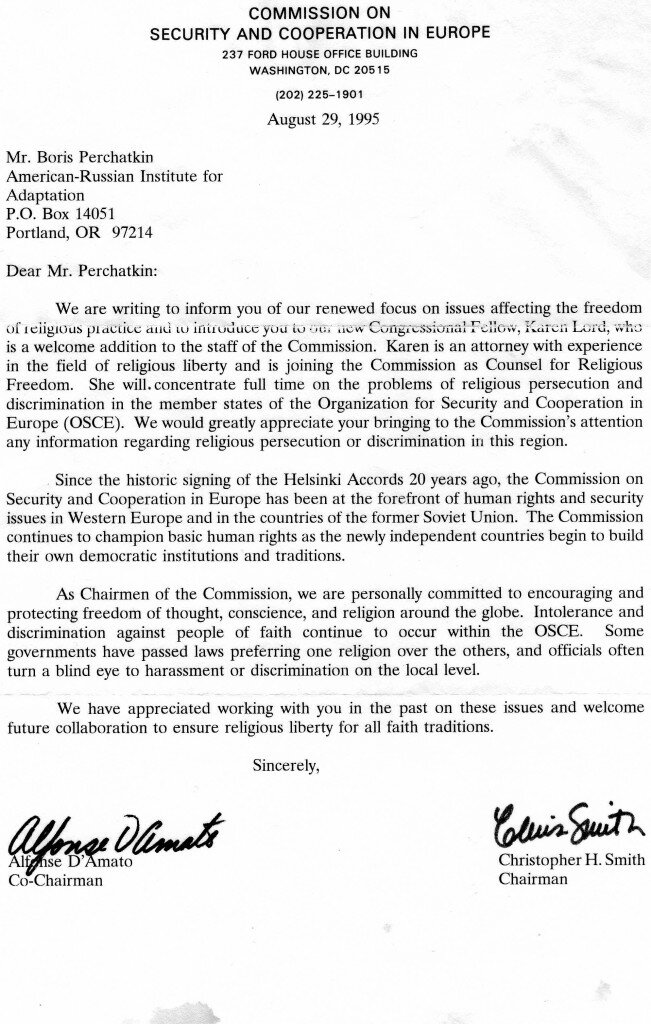
Письмо от 29 августа 1995 год Комиссии по безопастности и сотрудничеству в Европе, подписанное председателем Кристофером Х. Смитом и сопредседателем Алфонсом Д’Амато:

——————————————————————————————-
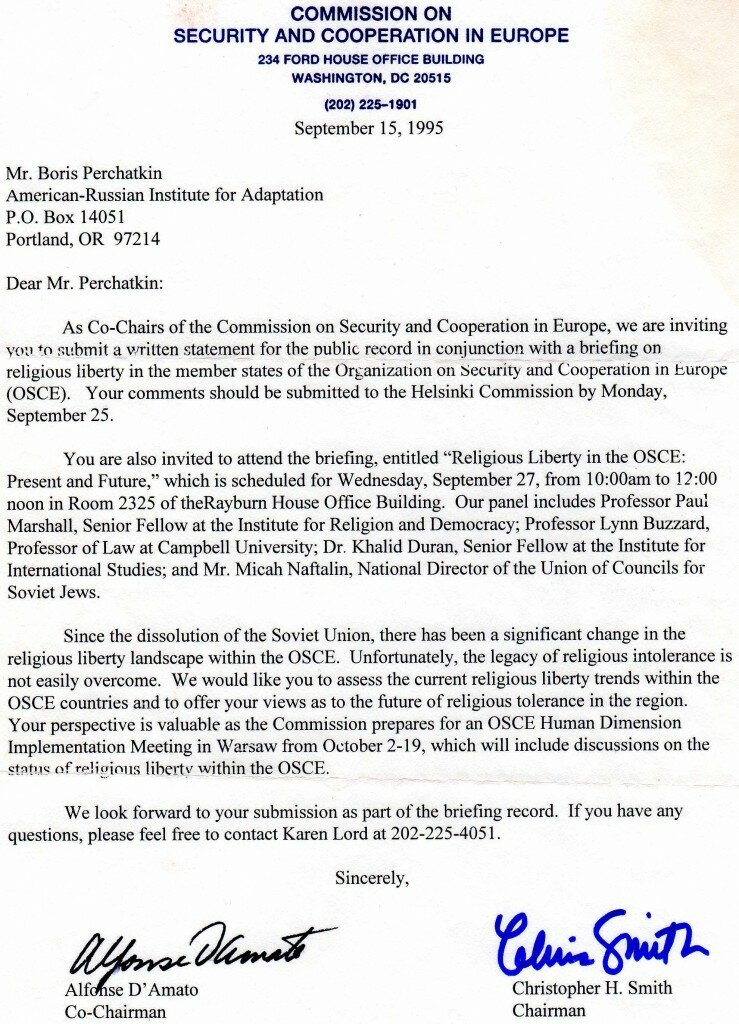
Письмо от 15 сентября 1995 год Комиссии по безопастности и сотрудничеству в Европе, подписанное председателем Кристофером Х. Смитом и сопредседателем Алфонсом Д’Амато:

————————————————————————————————
Письмо от 27 марта 2001 года от Комиссии США по Междунородной религиозной свободе, подписанное директором по связям Лоуренсом Дж. Гудричом:

————————————————————————————————
Письмо от Государственного департмента США от 30 ноября 2001 года, подписанное офицером иностранных дел офиса международной религиозной свободы доктором Нэнси Майто Хьюитт

————————————————————————————————
Письмо от Комиссии по безопастности и сотрудничеству в Европе от 6 апреля 2005 год, подписанное Семом Браунбэком:

UZBEKISTAN: Prisoner of conscience «released but not free»
By Mushfig Bayram, Forum 18 News Service https://www.forum18.org
Former prisoner of conscience Dmitry Shestakov, who was recently released from a four-year jail sentence continues to be placed by Uzbekistan under the severe restrictions of ‘administrative supervision’, Forum 18 News Service has learned. Among the restrictions Shestakov faces he has to for one year report to police in person almost every week, he may not be outside his home between 21.00 in the evening and 06.00 in the morning, he may not leave his home town without written police permission, and he cannot visit public places such as restaurants. The term of administrative supervision can be extended, and the punishments for breaking the supervision regime range up to imprisonment for four years. The authorities have refused to explain the reason for the restrictions to Forum 18. «He was released from prison but is not free,» a local Protestant complained. Current known long and short-term prisoners of conscience jailed for exercising freedom of religion or belief are Muslims, Jehovah’s Witnesses and Protestants. The latest two short-term prisoners of conscience are two Baptists jailed for distributing religious literature and carrying communion wine used in worship.
Former prisoner of conscience Dmitry Shestakov, who was recently released from a four-year jail sentence continues to be under severe restrictions, Forum 18 News Service has learned. For one year Shestakov has to report to police in person almost every week, may not be outside his home between 21.00 in the evening and 06.00 in the morning, and cannot visit places where alcohol is served such as restaurants. «He was released from prison but is not free,» one Protestant complained to Forum 18. Shestakov is the Pastor of an officially registered Full Gospel Pentecostal Church in the eastern city of Andijan [Andijon], who was imprisoned for exercising his right to freedom of religion or belief. Uzbek authorities are unwilling to explain to Forum 18 why they have placed Shestakov under these restrictions.
Shestakov was released on 21 January from Prison No. 29 in Navoi [Nawoiy], in central Uzbekistan, after a four-year sentence for allegedly violating Criminal Code articles:
- 216 («Illegal establishment or reactivation of illegal public associations or religious organisations, as well as active participation in their activities»);
- and 244-1 Part 2 («Any form of dissemination of information and materials containing ideas of religious extremism, separatism, and fundamentalism, calls for pogroms or violent eviction of individuals, or aimed at creating a panic among the population, as well as the use of religion in purposes of breach of civil concord, dissemination of calumnious and destabilizing fabrications, and committing other acts aimed against the established rules of conduct in society and of public order»).
He was sentenced, after an apparently rigged trial, in March 2007 to four years in an open work camp (see F18News 23 March 2007 https://www.forum18.org/Archive.php?article_id=935). The sentence was subsequently harshened to imprisonment in a labour camp where Jehovah’s Witness prisoners of conscience are also held (see F18News 27 June 2007 https://www.forum18.org/Archive.php?article_id=982).
NSS secret police presence at release
A large number of prison officials and National Security Service (NSS) secret police in plain clothes were present when Shestakov was released, and they refused to allow his lawyer to be present. Officials filmed the release on a video camera. Shestakov walked out of the prison gates in prison clothes – a dark jacket, dark trousers, and dark cap – as his wife and three daughters met him. Apart from two members of his church, no people from other churches were present, for fear of state reprisals. His family and church members were all crying for joy at the release.
Mother’s death
Shestakov’s mother had a stroke and was paralysed after his arrest. On his way home after his release Shestakov visited her, althgough she was in a coma when he saw her. «Soon after Shestakov’s visit she died on 24 January», a Protestant told Forum 18. Shestakov was, Forum 18 understands, allowed by police to bury his mother.
Current Muslim, Jehovah’s Witness and Protestant prisoners of conscience
Uzbekistan has many prisoners of conscience jailed for exercising their right to freedom of religion or belief. One Protestant is still a long-term prisoner of conscience, also after an apparently rigged trial. Tohar Haydarov was in March 2010 sentenced to 10 years in jail, and attempts to overturn his sentence have failed. There are also very many Muslim prisoners of conscience, notably readers of the works of Islamic theologian Said Nursi, jailed for long terms for exercising religious freedom (see F18News 21 December 2010 https://www.forum18.org/Archive.php?article_id=1524).
Three Jehovah’s Witness prisoners of conscience are also currently jailed. In April 2008 Olim Turaev was sentenced to four years in a labour camp (see F18News 29 April 2008 https://www.forum18.org/Archive.php?article_id=1122). In July 2008 Abdubannob Ahmedov was sentenced to a four year prison term and Sergey Ivanov to three and a half years (see F18News 29 July 2008 https://www.forum18.org/Archive.php?article_id=1164).
There are also short-term prisoners of conscience, jailed for up to 15 days under the Code of Administrative Offences. These have so far been Protestants, Jehovah’s Witnesses and Bahai’s (see F18News 26 November 2010 https://www.forum18.org/Archive.php?article_id=1514.
The latest short-term prisoners of conscience are two Baptists, Artur Alpayev and Edward Kim, from an unregistered Baptist Church in the eastern city of Fergana [Farghona]. All unregistered religious activity is a criminal offence, against Uzbekistan’s iunternational human rights obligations.
On 30 January the two Baptists were detained by police in Denau [Dinau] in the southern Surkhandarya Region for distributing Christian literature, and held for 15 hours in a police station. On 31 January they were sentenced in a short court hearing – lasting only a few minutes, local Baptists told Forum 18 – to seven days administrative arrest. The two were sentenced under the Administrative Code’s article’s 240 («Violation of the law on religious organisations») and 186 («Production and sale of home-made alcoholic drink»).
It is thought that the use of Article 186 is a reference to Communion Wine used in worship.
Why ‘administrative supervision’?
Soon after Pastor Shestakov’s release on 21 January, Prison No. 29′s administration asked Navoi Criminal Court to place Shestakov under administrative supervision, Protestants who wished to remain unnamed for fear of state reprisals told Forum 18. The Prison claimed that Shestakov was a persistent violator of the prison regime, which people who know him have strongly denied to Forum 18. The Court decided to place Shestakov under supervision for one year.
An independent human rights defender, speaking to Forum 18 on 2 February on condition of anonymity, noted that terms of administrative supervision vary between one month on one year. Shestakov was given the maximum term. «Usually only thugs or violent religious extremists are put under administrative supervision,» the human rights defender stated.
Nurmamad Ismailov, Governor of Prison Nr. 29, refused to talk to Forum 18 on 3 February. Asked what basis he had to ask the Court to put Shestakov under supervision, Ismailov said through his secretary (who did not give her name) that «the Prison is a closed place and I have no authority to comment». The Governor’s Secretary then said that he «will not answer».
Sherzod Mamedov, Chair of Navoi Criminal Court, refused to comment on his Court’s decision. He told Forum 18 on 3 February that «I cannot give you any information on the case over the phone». Asked what basis the Court had for its decision, he hung up the phone.
Ex-prisoners registered, suspected, and monitored
Like other released prisoners, Shestakov must be registered at Andijan Regional and Andijan City Police as well as the local Police inspector of his residential area, the human rights defender pointed out. He must be registered at the City Police’s Crime-Prevention and Criminal Investigation Divisions. «In such cases the local police Inspector usually demands that the ex-prisoner finds a job, and presents a written testimonial about himself from the authorities of a residential district or mahalla committee». Shestakov will also have to report to the police inspector every month.
Mahalla committees retain extensive records on local residents, especially on known active religious believers. These committees are used by the Uzbek regime as a key instrument in its attempts to control society (see eg. F18News 1 December 2005 https://www.forum18.org/Archive.php?article_id=698).
If a crime is committed close to Shestakov’s home, he can be summoned by the police to write a statement stating where he was when the crime was committed, the human rights defender said.
Before any major national public holiday, Shestakov will be summoned to the city police and asked to write a statement about himself.
What does administrative supervision mean?
As a person under administrative supervision, Shestakov must:
- 1. report in person to Andijan Regional Police no less than three times a month;
- 2. not visit places where alcohol is served, such as cafés, bars and restaurants;
- 3. not be outside the city of Andijan without the prior written consent of the Regional Police;
- and 4. not be outside his home between 21.00 in the evening and 06.00 in the morning.
Police have the right to, several times each night after 21.00, check that Shestakov is at home.
If Shestakov breaks the supervision regime, he may for a first alleged violation be given a fine up to three times the minimum salary under the Administrative Code’s Article 206 («Violation of the regulations of administrative supervision»).
If Shestakov is given an administrative punishment, the police will ask a court to extend the term of the supervision, the human rights defender explained. Administrative supervision may be extended by up to three years.
If the alleged violation is repeated, a case can be brought under the Criminal Code’s Article 226 («Violation of the regulations of administrative supervision»). This states that:
«Violation of the regulations of administrative supervision by a person subjected to such supervision, after an administrative penalty for the same act has been imposed shall be punished with a fine of up to 50 times the minimum monthly wage, or imprisonment for up to two years.
Violation of the regulations of administrative supervision by either:
- a.) leaving the place of residence with the purpose of evasion of administrative supervision;
- or b.) failure to be at the specified place of residence within the prescribed times without valid reasons, when administrative supervision is imposed after release from institutions of confinement;
shall be punished with imprisonment for between two to four years.»
Administrative supervision has some similarities to the banning orders of apartheid South Africa, depicted in the film ‘Cry Freedom’, used against dissidents such as former President and Nobel Peace Prize holder Nelson Mandela.
Protestants complained to Forum 18 that «all this is done to crush Shestakov and his church». «He is trying to adapt to freedom again», one Protestant said. «He was released from prison but he is not free».
What will the police do?
Daniyar Hamidov, Andijan Regional Police Criminal Investigator told Forum 18 on 3 February that he was not well-informed about the case. «I was recently transferred here, I do not lead those cases», he stated. He referred Forum 18 to police officer Batyr, without giving his last name. Officer Batyr’s phone went unanswered on 3 February.
«The police will do everything in their power to bring a criminal case against Shestakov, and send him back to prison,» Protestants complained. «Police may arrange the planting on him of narcotic drugs, cartridges, explosives, guns, or religious literature. They have done this to Muslims,» the human rights defender noted.
When current prisoner of conscience Tohar Haydarov was arrested in January 2010, it appears that drugs were planted on him (see F18News 9 February 2010 https://www.forum18.org/Archive.php?article_id=1406. Religious leaflets alleged by police to be extremist have apparently been planted on devout Muslims as police arrest them (see eg. F18News 27 January 2010 https://www.forum18.org/Archive.php?article_id=1399). (END)
For a personal commentary by a Muslim scholar, advocating religious freedom for all as the best antidote to Islamic religious extremism in Uzbekistan, see https://www.forum18.org/Archive.php?article_id=338.
For more background, see Forum 18′s Uzbekistan religious freedom survey at https://www.forum18.org/Archive.php?article_id=1170.
Full reports on freedom of thought, conscience and belief in Uzbekistan can be found at https://www.forum18.org/Archive.php?query=&religion=all&country=33.
A compilation of Organisation for Security and Co-operation in Europe (OSCE) freedom of religion or belief commitments can be found at https://www.forum18.org/Archive.php?article_id=1351.
Ukrainian` home-schooling concerns refugee advocates
By Emily Heffter
Times Snohomish County bureau One visit to his daughter`s public high school was enough to convince Lynnwood pastor Vladimir Monich that home- schooling would be better. He saw «all the people walking around half-naked or whatever,» said Monich`s son, 18-year-old Vlad, translating for his father.
Now Monich, whose family has been in the United States for seven years, spends an hour a day with his daughter, Julia, 16, teaching her about their Pentecostal faith and giving her tests on her schoolwork. She spends another hour or two each day studying by herself and expects to earn a high-school diploma next month. After that, she said, she plans to go to a community college. Читать далее
Congressman Steny H. Hoyer about Boris Perchatkin
Sacramento newspaper about Aleksandr Shevchenko’s church «House of Bread»
This is an article from Sacramento newspaper «Sacramento bee» of December 26th, 2010 about widely known Ukrainian-Russian pastor Alexandr Shevchenko (Александр Шевченко) of a neopentecostal church «House of bread» in Sacramento.
Spiritual bread for a new generation
On a dark, chilly Thursday night in Rio Linda, seven young women meet for tea and sympathy, blintzes and Bible study.
They talk about how men are like waffles (they compartmentalize things) and women like spaghetti (everything’s intertwined). They share the challenges of youths they know struggling with meth and raising children. Two are single moms.
По часовой стрелке слева, Ирина Минзер, Елена Давидюк, Курти Табално, Лилия Визитиу, Нэлли Кебец, Виталия Кыслянка и Жаклин Моралес-Вилла и ее младенец посещают домашнюю учебную группу "Дома хлеба" в Рио-Лында
Comparisons between The Majority (KJV) and Minority (NIV) Texts
Richard Anthony
This chart will compare the difference between the Minority Text (which are based upon mainly 2 corrupted New Testament manuscripts) and the Majority Text (which are based upon over 5,000 New Testament manuscripts). For this study, the King James Version (KJV) New Testament will be used, since the KJV is based upon the Majority Text, and all bibles that use the Majority Text are relevant to these readings. The KJV will be compared to the New International Version (NIV) New Testament, since the NIV is based upon the Minority Text, and almost all bibles published since 1898 are relevant to these readings because they are based upon these same corrupted manuscripts.
U.S. Commission on International Religious Freedom congratulates Boris Perchatkin on the twentieth anniversary of emigration from the USSR

U.S. Commission on International Religious Freedom
800 North Capitol Street, NW Suite 790 Washington, DC 20002
Dear Boris.
I wish to congratulate you on the twentieth anniversary of emigration from the Soviet Union after decades of persecution for religious belief. Your success in this difficult endeavor was the result of many long years of danger and dedication dating back to 1963. Your brave leaders, such as Vasily Patrushev and Fyodor Sidenko, started your long struggle to defend religious rights against relentless persecution, including labor camps, internal exile and discrimination. They led your many years of effort to emigrate.
Читать далее
LIFE DISPELS FEAR
SERIES: HE IS ALIVE! AND HE IS STILL ALIVE!
By Ron Ritchie
Many of us here have had the privilege of studying the history of the Christian church. We have seen both the blessings and the persecution of the followers of Jesus Christ in generation after generation. Jesus said that he would build his church and that the gates of Hades would not overpower it, but at times, especially in these times, it almost appears that Satan is gearing up to try to disrupt and destroy all that he can before the Lord comes back to rule in righteousness.
According to The National and International Religion Report (April 18, l994), a brutal persecution of Protestants is increasing steadily in the former Soviet Union. It seems that the Russian Orthodox church perceives Protestantism as an American plan to interfere in Russia, to even steal Russia from the Russians. And a systematic «cleansing» of Protestants similar to that experienced by those of all faiths under Stalin could occur soon in the Commonwealth of Independent States, said Boris Perchatkin, an evangelical Christian and former dissident. «Many Russian Christians fear for their lives and thousands are ready to leave….» Читать далее
Boris Perchatkin testimony to US commission on security and cooperation in Europe

Testimony :: Boris Perchatkin
President — American-Russian Relief Committee
Print
Dear ladies and gentleman!
The American Russian Relief Center requests that you take notice of the condition of former non-registered Pentecostal Churches in Russia. Читать далее
New York Times: 10 Years, a Postcard and Next, Israel
August 17, 1988
By ESTHER B. FEIN, Special to the New York Times
Читать далее
Slavic parents lose control of their Americanizing kids
by Gosia Wozniacka, The Oregonian
Saturday September 13, 2008, 10:15 PM
Mariya calls her children’s schools almost daily, or comes to school crying. Her three teenage sons smoke and drink, even in front of Mariya and her husband. They go out at night, don’t return home until morning and sometimes disappear for days. Her oldest dropped out of high school last year; another son did the same a few months ago. Her preteen daughter ran away from home. Читать далее